Landscaping Costs by Region 2026: How Your Location Affects What You Pay for Sod, Hardscape, and Labor
Landscaping Costs by Region 2026: How Your Location Affects What You Pay for Sod, Hardscape, and Labor
Published 2026-05-24 • Price-Quotes Research Lab Analysis
Why Your Zip Code Might Cost You $8,000 More Than Your Neighbor's
A homeowner in Phoenix and a homeowner in Boston both want to install a 1,000-square-foot paver patio and lay new sod. By the time both projects are complete, the Phoenix resident will have spent roughly $6,200. The Boston resident? Closer to $14,500. Same scope. Same year. Different regions. That gap isn't padding a contractor's profit margin — it's the structural difference in how much labor, materials, and overhead cost in different parts of the country.
Understanding regional landscaping cost variation is the single most powerful tool a homeowner has for setting realistic budgets and identifying when a bid is genuinely inflated. This guide breaks down 2026 landscaping costs by region — covering sod, hardscape materials, and labor — so you know exactly what a fair price looks like before you sign anything.
How Regional Landscaping Costs Are Calculated in 2026
Before diving into specific numbers, it helps to understand what actually drives regional price variation. Landscaping costs aren't arbitrary — they reflect three overlapping realities:
- Labor market rates by state and metro area, which track with local cost of living and union presence
- Material sourcing logistics — whether materials are produced locally or must be shipped long distances
- Climate-driven demand cycles that create peak seasons and pricing pressure in different windows across regions
Price-Quotes Research Lab observes that regional cost variation for identical landscaping scopes has widened by approximately 12% since 2024, driven primarily by labor market tightening in the Northeast and West Coast and by fuel surcharges affecting material delivery in rural Midwest and Southern markets.
Regional Labor Costs for Landscaping in 2026
Labor typically represents 40–60% of a landscaping project's total cost. Regional labor rates in 2026 reflect local economic conditions, licensing requirements, and the density of the landscaping contractor market. Here's what you're working with by region:
| Region | Hourly Labor Rate (2026) | Notes |
|---|---|---|
| South (TX, FL, GA, NC, AL) | $45–$65/hr | Most competitive rates; large contractor pool |
| Southwest (AZ, NM, NV) | $50–$70/hr | Growing demand; heat reduces work windows |
| Midwest (IL, OH, MI, WI, MN) | $55–$75/hr | Moderate rates; strong seasonal demand May–Sept |
| Northeast (NY, NJ, MA, CT, PA) | $70–$100/hr | Highest rates; licensing requirements add cost |
| West (CA, OR, WA, CO) | $65–$110/hr | Wide range; CA and Bay Area at the high end |
These are base hourly rates for skilled landscaping labor. Expect to pay a 15–25% premium for crews with specialized certifications (e.g., irrigation system installation, retaining wall engineering). For context, a full hardscape project requiring 80 labor hours at Northeast rates could carry $5,600–$8,000 in labor alone — compared to $3,600–$5,200 for the same 80 hours in the South.
Sod Costs by Region in 2026
Sod pricing in 2026 varies by grass type, harvest proximity, and regional climate. The cost per square foot includes the material itself and typically covers delivery within 30 miles of the supplier. Installation — including ground prep and labor — adds another $1.50–$4.00 per square foot depending on region.
Sod Material Cost by Grass Type and Region
| Grass Type | Best Suited Regions | Material Cost/Sq Ft (2026) | Installed Cost/Sq Ft (2026) |
|---|---|---|---|
| Bermuda | South, Southwest, Southern CA | $0.35–$0.65 | $1.80–$3.50 |
| St. Augustine | South, Gulf Coast, FL | $0.45–$0.80 | $2.00–$4.00 |
| Fescue (tall) | Midwest, Pacific NW, Transition Zone | $0.40–$0.75 | $1.90–$3.80 |
| Kentucky Bluegrass | Northeast, Upper Midwest | $0.50–$0.90 | $2.20–$4.50 |
| Zoysia | South, Transition Zone, TX | $0.55–$1.00 | $2.50–$5.00 |
For a typical 1,000 sq ft lawn, installed Kentucky Bluegrass in the Northeast runs $2,200–$4,500 in 2026. The same lawn in Bermuda sod in the South: $1,800–$3,500. The species difference matters, but the regional labor and overhead difference matters more.
Regional Sod Cost Factors
Three things push sod costs above the baseline in specific regions:
- Northeast and Midwest: Shorter growing seasons mean sod is harvested and installed in tighter windows (April–June, September–October). This creates price spikes of 10–20% during peak planting season.
- Pacific Northwest and Mountain West: Limited local sod production means material is often shipped from California or the Upper Midwest, adding $0.15–$0.30 per square foot in freight costs.
- California: Water restrictions and drought conditions have shifted demand toward drought-tolerant varieties (bermudagrass, tall fescue blends), which are 15–25% more expensive than standard bluegrass but reduce long-term irrigation costs.
Hardscape Costs by Region in 2026
Hardscape — patios, walkways, retaining walls, fire pits — is where regional cost variation becomes most dramatic. Material choice, site accessibility, and local permit requirements all factor in, but labor rate differences alone can swing a project's total cost by 30–50%.
Paver and Patio Costs by Region
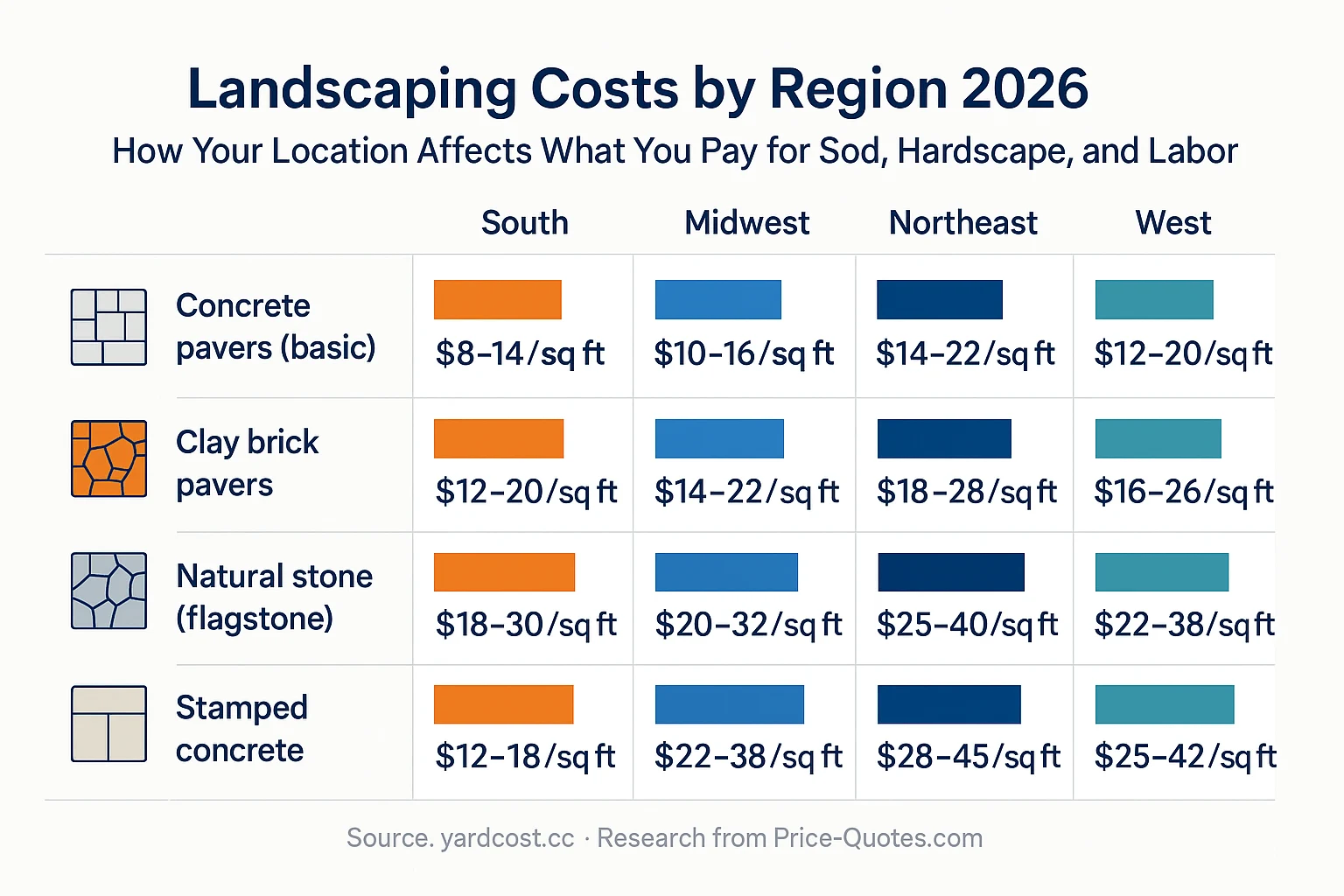
All prices above reflect installed cost including base preparation, labor, and sealing where applicable. A 400-square-foot natural stone patio in the Northeast could cost $10,000–$16,000 in 2026. The same patio in the South: $7,200–$12,000.
Retaining Wall Costs by Region
Retaining walls add another layer of regional cost complexity because they often require engineering and drainage considerations that vary by soil type and local building codes.
- Gravity walls (segmental block, 3–4 ft tall): South $55–$90/linear ft | Midwest $65–$100/linear ft | Northeast $85–$140/linear ft | West $75–$125/linear ft
- Timber walls (treated, 3–4 ft): South $35–$55/linear ft | Midwest $40–$65/linear ft | Northeast $55–$85/linear ft | West $50–$75/linear ft
- Segmental retaining wall systems with geogrid: Add $15–$30/linear ft across all regions for engineering and reinforcement materials
Northeastern homeowners should budget an additional $500–$2,000 for engineering stamps and permit fees on retaining walls exceeding 3 feet in height — a requirement in many municipalities in New York, New Jersey, and Massachusetts.
What Else Drives Regional Landscaping Cost Variation
Material Transport and Availability
Regions with limited local production of landscaping materials carry a hidden cost premium. According to data from the National Association of Landscape Professionals, material transport adds $200–$800 to typical residential projects in rural areas and regions without local quarries or sod farms. The Midwest and Mountain West are particularly affected for natural stone and premium pavers, which are often shipped from regional distribution hubs in Texas, Arizona, or the Pacific Northwest.
Climate and Seasonal Timing
Regional climate doesn't just determine which materials you use — it determines when you can use them, which directly affects price.
- Northeast: Peak landscaping season is May–September. Projects booked in April or October carry 5–15% premiums due to unpredictable weather windows and shortened crew availability.
- South: Spring (March–May) and fall (September–November) are peak seasons. Summer heat reduces afternoon work capacity in TX, AZ, and FL, often pushing projects into early morning or evening hours.
- West Coast: California's year-round growing season means less seasonal pricing pressure, but drought restrictions can limit irrigation-dependent installations between June–September.
- Pacific Northwest: October–March rains effectively shut down new installation work, concentrating all demand into a 7-month window.
Permit and Regulatory Costs
Permit requirements vary significantly by municipality, but regional patterns emerge:
- Northeast: Most municipalities require permits for drainage work, retaining walls over 3 ft, and any project adjacent to wetlands or water features. Permit costs range from $300–$2,500 depending on scope.
- California: Stormwater management requirements for impervious surfaces (patios, driveways over a certain square footage) add $400–$1,500 in compliance costs.
- South and Midwest: Suburban and rural areas often have minimal permit requirements for purely aesthetic landscaping, keeping regulatory costs low.
Regional Cost Comparison: Full Project Examples
Here's how the numbers stack up for two common full-scope landscaping projects across different regions in 2026:
| Project Scope | South (2026) | Midwest (2026) | Northeast (2026) | West (2026) |
|---|---|---|---|---|
| 1,000 sq ft Bermuda sod (installed) | $1,800–$3,500 | $2,200–$4,200 | $2,800–$5,200 | $2,400–$4,600 |
| 400 sq ft paver patio (concrete pavers) | $3,200–$5,600 | $4,000–$6,400 | $5,600–$8,800 | $4,800–$8,000 |
| 30 ft segmental retaining wall (3 ft) | $1,650–$2,700 | $1,950–$3,000 | $2,550–$4,200 | $2,250–$3,750 |
| Irrigation system (1/4 acre) | $2,200–$3,800 | $2,500–$4,200 | $3,200–$5,500 | $2,800–$4,800 |
For more detailed breakdowns on irrigation system costs by system type, see our full guide on irrigation system installation costs in 2026.
How to Use This Data to Get Better Bids
Knowing regional cost ranges transforms how you approach contractor bids. Here's how to put this data to work:
Get Regionally Calibrated Estimates
Before requesting bids, identify the cost range for your region and project type. A bid that falls 30% below your region's range isn't a deal — it's a red flag for scope cuts, unlicensed labor, or hidden charges. A bid 20% above the range warrants a detailed line-item explanation.
Time Your Project Strategically
If your region has an off-season window, use it. Contractors in the Midwest and Northeast often offer 10–20% discounts for projects booked in late October through November or in early March before the spring rush. Southern contractors may discount 8–15% during the slower summer months if the project doesn't involve new plant installation.
Compare Apples to Apples
Request itemized bids that separate labor, materials, overhead, and permit fees. This is the only way to compare bids fairly across contractors, and it forces you to understand exactly where your money is going. Our complete landscaping cost guide for 2026 has a full scope checklist you can bring to any contractor meeting.
Factor in Long-Term Value
Regional cost differences sometimes reflect material quality differences rather than pure overhead. A contractor in the Southwest using drought-tolerant plant material may cost more upfront but dramatically reduce irrigation bills — a calculation that flips the regional cost comparison over a 5-year horizon.
What to Do Next
Regional cost data is your starting point, not your final budget. Here's the sequence:
- Identify your region and cost range using the tables above for your specific project type
- Get three itemized bids from licensed contractors in your area — compare line items, not just totals
- Ask about timing discounts if your project is flexible by 4–6 weeks
- Verify permit requirements with your local building department before signing a contract
- Use a cost research tool like price-quotes.com to cross-reference regional rates before committing
Landscaping is a long-term investment. The homeowners who get the best results aren't the ones who find the cheapest bid — they're the ones who know what a fair price looks like before they pick up the phone.