Paver Patio Installation Costs 2026: Concrete vs Brick vs Natural Stone Pricing Breakdown
Paver Patio Installation Costs 2026: Concrete vs Brick vs Natural Stone Pricing Breakdown
Published 2026-06-09 • Price-Quotes Research Lab Analysis
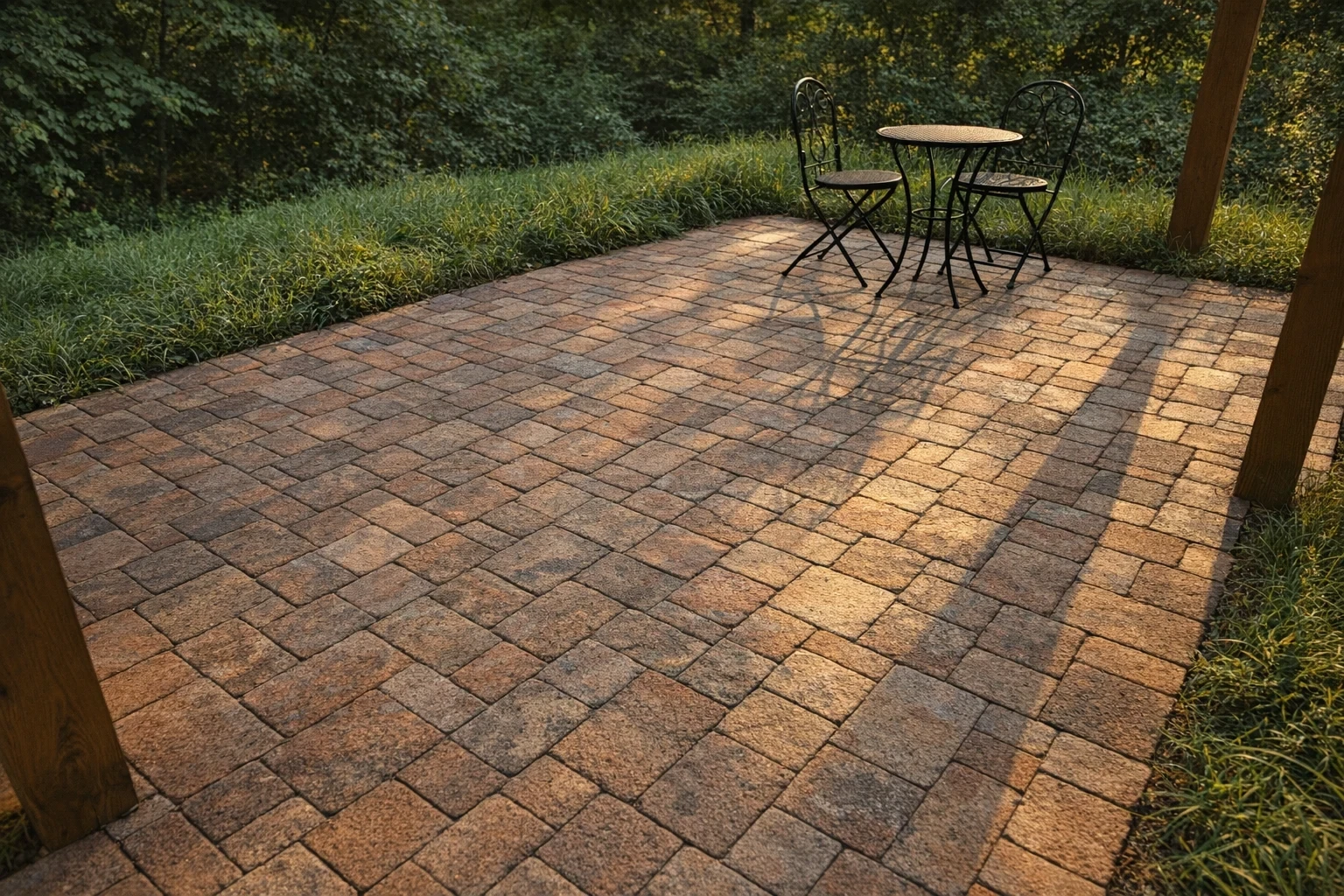
The $14,000 Surprise: What One Homeowner Learned About Paver Patio Costs
When Marcus Delgado of Columbus, Ohio received a quote of $14,200 for a 320-square-foot paver patio in spring 2026, he assumed the contractor was gouging him. He'd seen online estimates of "$8–$12 per square foot installed," and his project was only 320 square feet. The math, he thought, should come to roughly $3,200.
What Delgado didn't understand—and what most homeowners don't—is that the per-square-foot figure refers only to the pavers and their installation. It excludes the excavation, gravel base, edging, drainage, labor overhead, and site preparation that typically add $15–$25 per square foot on top of material costs. When all factors are included, a realistic budget for a quality paver patio in 2026 runs $25–$75 per square foot, depending on materials and site conditions.
Delgado's final project cost $14,200—actually reasonable for his specifications. But he nearly walked away from a patio he loves because he didn't understand the pricing breakdown. This guide exists so you don't make the same mistake.
What You're Actually Paying For: The Cost Components
Before comparing materials, you need to understand where your money goes. A paver patio isn't just stones placed on dirt. It's a engineered system, and each layer adds cost—and value.
The Five Cost Layers of Any Paver Patio
1. Excavation and Site Preparation ($2–$5 per square foot)
Contractors must remove existing soil, grass, or vegetation to create a stable foundation. In Columbus, where clay soil is common, this often requires going 6–8 inches deep. This layer alone represents $640–$1,600 for a 320-square-foot patio.
2. Gravel Base and Compaction ($3–$8 per square foot)
A proper base uses 4–6 inches of compactable gravel (typically crushed limestone or granite). This layer provides drainage and prevents settling. For Delgado's project, this added $960–$2,560.
3. Edging and Restraints ($5–$15 per linear foot)
Edging keeps pavers from spreading outward over time. Plastic edging, steel edging, or concrete mow strips all qualify. At 60–70 linear feet for a 320-square-foot rectangular patio, expect $300–$1,050 for this component.
4. Bedding Sand and Installation ($10–$20 per square foot)
Fine sand is screeded over the gravel base, and pavers are placed, cut at edges, and compacted. This includes the labor for pattern layout, cutting, and final compaction. For Delgado: $3,200–$6,400.
5. The Pavers Themselves (Variable by Material)
Here's where material choice dramatically affects your total. This is the component that varies most widely between concrete, brick, and natural stone.
Material Comparison: Concrete vs Brick vs Natural Stone
Each material has distinct cost characteristics, longevity profiles, and aesthetic trade-offs. Here's the 2026 data.
Concrete Pavers: The Value Leader
Concrete pavers dominate the American market, accounting for roughly 70% of residential paver installations according to industry data from the Interlocking Concrete Pavement Institute. They range from $3–$12 per square foot for standard styles, with premium textures and colors reaching $15–$25 per square foot.
2026 Average Costs for Concrete Paver Installation:
| Project Size | Materials Only | Materials + Installation | Full Project (All Layers) |
|---|---|---|---|
| 100 sq ft | $400–$1,200 | $1,500–$3,500 | $2,500–$5,500 |
| 200 sq ft | $800–$2,400 | $3,000–$7,000 | $5,000–$11,000 |
| 400 sq ft | $1,600–$4,800 | $6,000–$14,000 | $10,000–$22,000 |
| 600 sq ft | $2,400–$7,200 | $9,000–$21,000 | $15,000–$33,000 |
Concrete pavers offer the best cost-to-durability ratio. They're manufactured to consistent dimensions, making installation straightforward. They resist cracking better than poured concrete because they flex slightly under load. Most manufacturers offer 25-year warranties on structural integrity.
However, concrete pavers can fade over 10–15 years, especially in direct sunlight. They also have a more uniform, "manufactured" appearance that some homeowners find less appealing than natural materials.
Brick Pavers: The Mid-Range Classic
Clay brick pavers evoke traditional aesthetics and often carry a premium perception. They're priced at $8–$18 per square foot for standard sizes, with reclaimed or specialty bricks reaching $20–$35 per square foot.
2026 Average Costs for Brick Paver Installation:
| Project Size | Materials Only | Materials + Installation | Full Project (All Layers) |
|---|---|---|---|
| 100 sq ft | $800–$1,800 | $2,000–$4,500 | $3,000–$6,500 |
| 200 sq ft | $1,600–$3,600 | $4,000–$9,000 | $6,000–$13,000 |
| 400 sq ft | $3,200–$7,200 | $8,000–$18,000 | $12,000–$26,000 |
| 600 sq ft | $4,800–$10,800 | $12,000–$27,000 | $18,000–$39,000 |
Brick offers excellent longevity—properly installed brick patios can last 50+ years. The color is inherent to the material, not a surface coating, so fading is minimal. Brick also performs well in freeze-thaw cycles when properly installed with adequate base depth.
The trade-off is installation complexity. Bricks are less uniform than concrete pavers, requiring more skill to lay evenly. They're also more susceptible to chipping and may settle unevenly if the base preparation is inadequate.
Natural Stone: The Premium Choice
Natural stone represents the highest price tier, with costs varying dramatically by stone type. Blue stone, granite, travertine, and flagstone each have distinct characteristics and price points.
2026 Average Costs for Natural Stone Paver Installation:
| Project Size | Materials Only | Materials + Installation | Full Project (All Layers) |
|---|---|---|---|
| 100 sq ft | $1,500–$5,000 | $3,500–$10,000 | $4,500–$13,000 |
| 200 sq ft | $3,000–$10,000 | $7,000–$20,000 | $9,000–$26,000 |
| 400 sq ft | $6,000–$20,000 | $14,000–$40,000 | $18,000–$52,000 |
| 600 sq ft | $9,000–$30,000 | $21,000–$60,000 | $27,000–$78,000 |
Natural stone offers unmatched aesthetic appeal and can increase property value more than manufactured alternatives. Stone types vary significantly: Pennsylvania blue stone runs $8–$20 per square foot, while premium granite or travertine can reach $30–$50 per square foot.
The primary drawback is installation complexity. Natural stone is irregular—each piece differs slightly in thickness and dimensions. This requires more labor for sorting, placement, and leveling. Poor installation leads to settling, uneven surfaces, and drainage problems.
Regional Price Variations: Why Your Zip Code Matters
Location significantly affects paver patio costs. Labor rates, material availability, and local regulations all play roles. According to our analysis of regional landscaping costs, metropolitan areas typically see 20–40% higher costs than rural regions for equivalent work.
2026 Regional Cost Multipliers for Paver Installation:
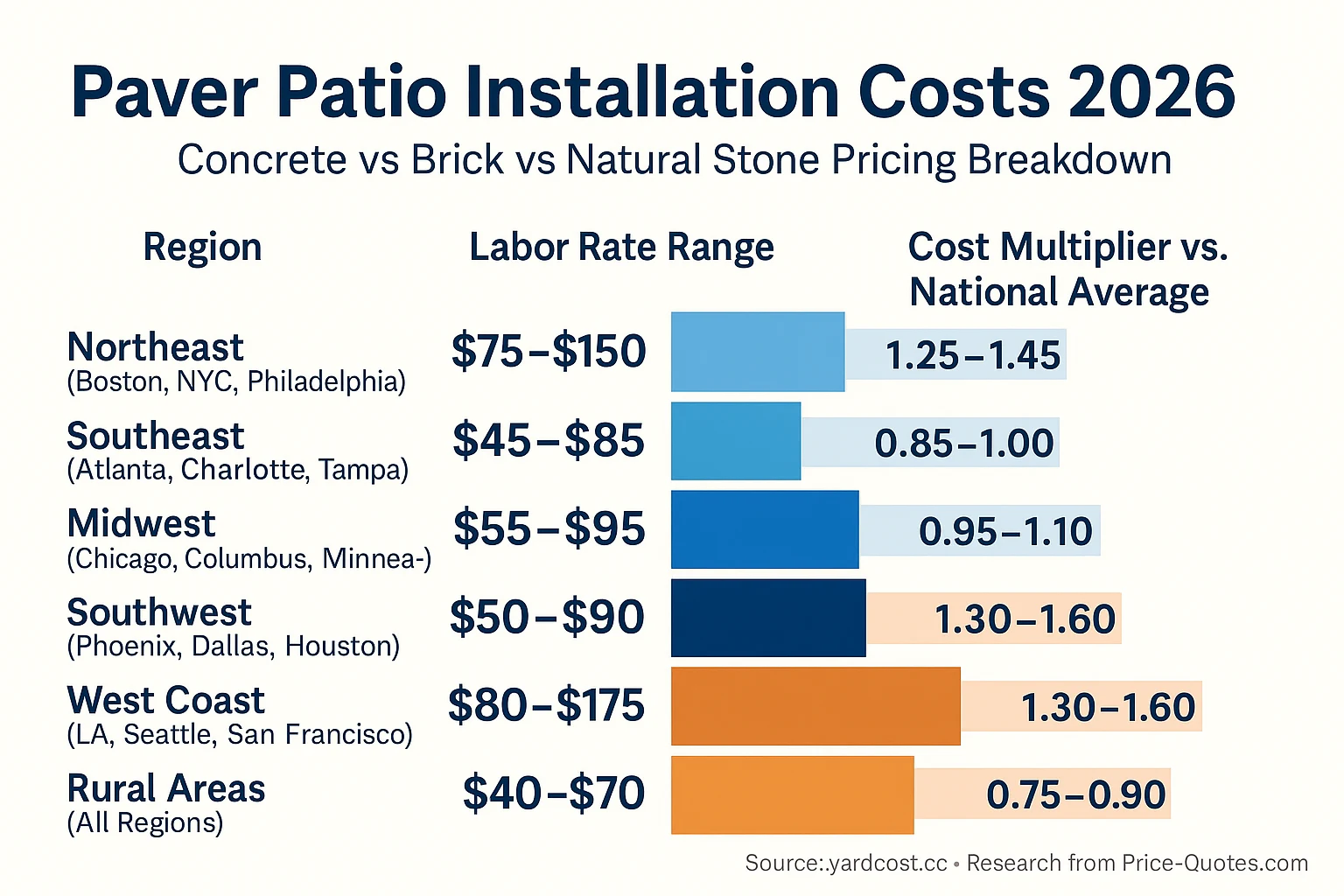
For more detailed regional pricing data, see our regional landscaping costs guide which covers how location affects landscaping investments.
Material availability also varies by region. In the Northeast, locally quarried bluestone is abundant and relatively affordable. In the Midwest, concrete pavers dominate due to manufacturing proximity. In the Southwest, flagstone and travertine are more common than in other regions.
Hidden Costs That Surprise Homeowners
Beyond the standard layers, several factors can unexpectedly increase your paver patio costs in 2026.
Drainage Solutions ($500–$3,000)
If your yard has poor drainage, you may need French drains, dry wells, or channel drains. This isn't optional—poor drainage causes settling, ice heaving, and premature failure. A simple French drain adds $500–$1,500; complex drainage systems can reach $3,000+.
Site Access Challenges ($200–$1,500)
Narrow gates, multiple levels, or rear-yard installations that require wheelbarrow transport add labor time. Contractors often charge $200–$500 extra for difficult access; some refuse the job entirely if access is severely constrained.
Existing Structure Removal ($300–$2,000)
Removing an old concrete patio, deck, or other structures adds significant cost. Concrete removal alone runs $2–$5 per square foot plus disposal fees of $100–$400 per load.
Permit and Inspection Fees ($100–$500)
Many municipalities require permits for patio construction, especially if drainage is altered or the project is large. Fees vary widely—check with your local building department.
Landscape Relocation ($300–$2,000)
Moving sprinkler heads, landscape lighting, or existing plantings adds cost. Our tree and landscape removal cost guide covers these considerations in detail.
The Labor Reality: Why Installation Quality Matters
Labor typically represents 50–65% of your total paver patio cost. This isn't padding—proper installation requires skill, and the difference between a $50/hour installer and an $85/hour installer often shows within five years.
According to contractor interviews conducted by Price-Quotes Research Lab, the most common installation failures stem from three issues:
- Inadequate base preparation (40% of failures) — Gravel base that's too shallow or improperly compacted leads to settling
- Poor edging installation (30% of failures) — Edging that isn't secured allows pavers to spread, creating gaps and trip hazards
- Insufficient slope (20% of failures) — Patios need 1/4 inch per foot slope minimum for drainage; inadequate slope causes water pooling
- Cutting errors (10% of failures) — Improperly cut edge pavers or uneven joints reduce both aesthetics and structural integrity
Price-Quotes Research Lab observes that homeowners who prioritize installation quality over the lowest bid save an average of $2,000–$5,000 in repair costs over a 15-year period. The cheapest bid rarely produces the best long-term value.
Design Complexity: How Patterns Affect Cost
Simple grid patterns cost the least to install. Every additional design element adds labor time and material waste.
| Pattern Type | Labor Multiplier | Material Waste Factor | Cost Impact |
|---|---|---|---|
| Simple running bond (grid) | 1.0x | 5–8% | Baseline |
| Herringbone (45° or 90°) | 1.2–1.3x | 8–12% | +15–25% |
| Random ashlar (mixed sizes) | 1.1–1.2x | 10–15% | +10–20% |
| Circle or radial patterns | 1.4–1.6x | 12–18% | +30–50% |
| Custom artistic designs | 1.5–2.0x | 15–25% | +50–100% |
A 400-square-foot herringbone pattern adds approximately $1,200–$2,400 in labor costs compared to a simple grid. Circle patterns in the same size could add $2,400–$4,000.
Maintenance Costs Over Time
Initial cost is only part of the equation. Long-term maintenance varies significantly by material.
Concrete Pavers:
- Annual cleaning: $100–$300 (DIY) or $300–$600 (professional)
- Resealing every 3–5 years: $0.50–$1.50 per square foot
- Weed control (joint sand replacement): $200–$500 every 5–8 years
- Potential color fading after 10–15 years
Brick Pavers:
- Annual cleaning: $100–$300 (DIY) or $300–$600 (professional)
- Resealing every 4–6 years: $0.40–$1.20 per square foot
- Weed control: Similar to concrete, but brick's rougher surface may require more frequent attention
- Minimal fading—color is inherent to the material
Natural Stone:
- Annual cleaning: $150–$400 (DIY) or $400–$800 (professional)
- Resealing frequency varies by stone type: 2–5 years
- Some stone types (limestone, sandstone) may require more frequent sealing
- Individual cracked or damaged stones can be replaced without full patio reconstruction
Over 25 years, maintenance costs for a 400-square-foot patio range from $2,500–$5,000 for concrete, $2,000–$4,500 for brick, and $3,000–$7,500 for natural stone (higher for porous stone types).
Making the Material Decision: A Practical Framework
Choose based on these factors, not just initial price:
Choose Concrete Pavers If:
- Budget is a primary constraint
- You want the widest variety of colors, shapes, and textures
- Your climate experiences freeze-thaw cycles (concrete handles this well)
- You plan to sell your home within 10–15 years (good ROI)
Choose Brick Pavers If:
- Traditional aesthetics are important to you
- You want excellent longevity with minimal maintenance
- Your home has brick siding or other brick elements
- You want a classic look that won't date
Choose Natural Stone If:
- Premium aesthetics are your priority
- Budget allows for the higher upfront investment
- You want the best potential property value increase
- You're planning to stay in your home long-term
Getting Accurate Quotes: The Bidding Process
Never accept a single quote for a project of this magnitude. Here's how to get meaningful comparisons:
Request Itemized Bids
Ask for bids that break down:
- Excavation and site preparation costs
- Gravel base material and installation
- Edging type and linear footage cost
- Sand and bedding layer
- Paver material cost (per square foot, by product name)
- Installation labor (hours and rate)
- Any additional features (drainage, steps, walls)
Verify Credentials
Confirm that your contractor carries:
- General liability insurance ($1M minimum recommended)
- Workers' compensation insurance
- State contractor's license (where applicable)
- ICPI certification (for interlocking pavement installers)
Check References Specifically
Ask for 3–5 references from projects completed 2–5 years ago. Call them. Ask about:
- Whether the project stayed on budget
- Whether the timeline was met
- Whether any issues arose after completion
- Whether they'd hire the contractor again
For additional context on landscaping project costs, visit Price-Quotes.com to compare quotes from multiple contractors in your area.
What to Do Next: Your Action Plan
Based on everything above, here's your step-by-step path to a successful paver patio project:
Step 1: Define Your Budget Range (Week 1)
Decide what you can realistically spend. Use the tables above to understand what your budget gets you in each material tier. Don't forget to add 15–20% contingency for unexpected issues.
Step 2: Get At Least Three Bids (Weeks 2–4)
Invite contractors to your property. Walk the site together. Ask them to explain their base preparation approach. Get written, itemized bids.
Step 3: Verify References and Insurance (Week 3–4)
Call references. Confirm insurance certificates directly with the insurance provider, not just the contractor's copy.
Step 4: Review Bids Carefully (Week 4–5)
Compare line by line. The lowest bid isn't necessarily the best value. Look for red flags: unusually low base depth, missing edge restraints, no drainage provisions.
Step 5: Sign a Detailed Contract (Week 5–6)
Your contract should include: start and completion dates, payment schedule, specific products by name, base depth specifications, slope requirements, warranty terms, and cleanup provisions.
Step 6: Prepare for Construction (Week Before)
Mark sprinkler heads, landscape lighting, and any underground utilities. Discuss access routes with your contractor. Plan for noise and dust.
Step 7: Monitor the Project
Visit daily during active construction. Check that the base is being properly compacted in lifts. Verify slope before sand is placed. Don't micromanage, but do observe.
Final Thoughts
A paver patio is a significant investment—one that should bring you years of enjoyment and add real value to your home. The key is understanding where your money goes and prioritizing quality over lowest cost.
Marcus Delgado, the homeowner from our opening example, eventually hired a contractor who explained the pricing breakdown clearly. His $14,200 patio has been in place for three years now, with no settling, no drainage issues, and compliments from every visitor. He considers it the best outdoor investment he's made.
You can have the same result. It just requires doing your homework, getting multiple bids, and understanding that the numbers in this guide represent real costs for real projects in 2026.